
Your Team Isn't Short on Ownership. It's Short on Room.
Many leaders feel they have to be the one with the answers, and their teams learn to wait. Here's why leading by intent, guided by purpose and values, gets people owning the solution and the results.

“Our people just don’t take ownership.”
If you lead a growing company, there’s a good chance you’ve said this, or at least thought it after a long week. Things slip. Problems land on your desk that someone else could have solved. You find yourself checking, double-checking, and stepping in more than you’d like.
It’s frustrating. And it’s real.
But here’s the part that’s harder to hear: in most cases, ownership isn’t missing because people don’t care. It’s missing because there’s no room for it. Somewhere along the way, the leader became the person who knows the answer, and the team learned to wait for it.
Let’s talk about how that happens, what it feels like on both sides, and what changes when leaders start leading by intent instead of by instruction.
The leader’s dilemma: why we manage when we should lead
Most leaders of small and mid-sized companies didn’t get there by accident. You built something. You knew every customer, every process, every corner of the business. For years, being the one with the answers was the job, and it worked.
Then the company grew. Ten people became twenty, then forty. Suddenly there are more decisions than one person can make well. But the habit of being the answer doesn’t go away just because the org chart changed.
There are good reasons the urge to manage is so strong:
- It feels faster. Explaining the why takes time. Just telling someone what to do takes thirty seconds.
- It feels safer. If you make the call, you control the risk. Mistakes feel less likely.
- It feels like your role. Many leaders quietly believe that if they don’t know better than their team, they aren’t earning their seat.
- Growth adds pressure. When things are moving fast and stakes are high, falling back on control is a very human response.
None of this comes from a bad place. It usually comes from caring a lot.
But consider this scenario. An operations lead walks into the owner’s office with a problem: orders are shipping late. The owner listens for two minutes, spots the issue, and lays out exactly what to change. The fix works. Everyone moves on.
Now picture that same conversation happening fifty times over a year, across every department. Each time, the leader solves it. Each time, the team learns one thing: bring problems up, wait for the answer, do what you’re told.
That’s not a team that lacks ownership. That’s a team that’s been trained out of it.
Without meaning to, the leader has started competing with the team in knowing better, instead of helping the team get better at knowing.
The view from the other side of the desk
Now let’s flip it around and look at this from a team member’s point of view.
Consider this scenario. A customer service lead has a clear idea for cutting response times. She’s close to the work. She sees the patterns every day. But in the team meeting, the owner has already laid out the plan, and it’s different from what she would do.
She has a choice. She can push back in front of everyone and risk looking difficult. Or she can nod, say “sounds good,” and do it the way she was told.
Most people pick the second option. Not because they’re weak, but because speaking up feels risky, especially when the person with the plan signs their paycheck.
So she follows the plan. She does it well enough. But her heart isn’t in it, because it’s not her plan. And if it doesn’t work? It’s not on her. “I did what I was asked.”
This is where fingerpointing comes from. It’s where “that’s not my call” comes from. It’s where doing exactly enough comes from. People don’t defend solutions they didn’t help create.
Researcher Amy Edmondson calls the missing ingredient psychological safety: the shared belief that it’s safe to speak up, disagree, and take a risk without being punished for it. When that safety is missing, the best ideas in your company stay quietly in people’s heads.
The cost isn’t just lower engagement. It’s every better idea your team had and never said out loud.
A different deal: leading by intent
There’s another way to lead, and it’s been around for a long time.
Retired submarine captain L. David Marquet describes it in Turn the Ship Around! Instead of giving orders and waiting for “request permission to…”, he asked his officers to come to him with “I intend to…”. The thinking moved back to the people closest to the information. The captain’s job shifted from making every decision to making sure people had the clarity and competence to make good ones.
Gino Wickman makes a similar point in How to Be a Great Boss (written with René Boer): give clear direction, provide the tools, and then let go of the vine. Hold on too tight, and every decision waits for you.
This idea shows up again and again in classic leadership thinking:
- Jim Collins, in Good to Great, found that the leaders who built lasting great companies weren’t the loudest or most brilliant people in the room. His “Level 5” leaders combined deep personal humility with fierce will for the company’s success. He contrasted them with the “genius with a thousand helpers” model, which tends to fall apart when the genius leaves.
- John C. Maxwell’s The 5 Levels of Leadership describes how leadership grows from position (people follow because they have to) to people development (leaders who grow other leaders). The real influence lives at the higher levels, and you only get there by investing in people, not by out-knowing them.
- Rasmus Hougaard and Jacqueline Carter, in The Mind of the Leader, point to selflessness as a core leadership quality: getting your ego out of the way so others can step forward.
- Daniel Pink’s Drive reminds us that people do their best work when they have autonomy, mastery, and purpose, not just a list of instructions.
Different authors, different decades, same message: the leader’s job isn’t to have every answer. It’s to build a team that finds better answers than the leader would alone.
Where purpose and values come in
Here’s the fear that keeps many leaders holding on: “If I stop telling people what to do, won’t everyone just go in different directions?”
It’s a fair question. Intent without direction can turn into chaos. That’s why leading by intent only works when it’s anchored in something deeper.
At Aligned On Purpose, we think of it this way:
- Intent says what good looks like and why it matters. It describes the outcome, not every step to get there.
- Purpose says where we’re going. It gives every decision a direction to point toward.
- Values say how we behave on the way there. They’re the guardrails, the lines we hold even when no one is watching.
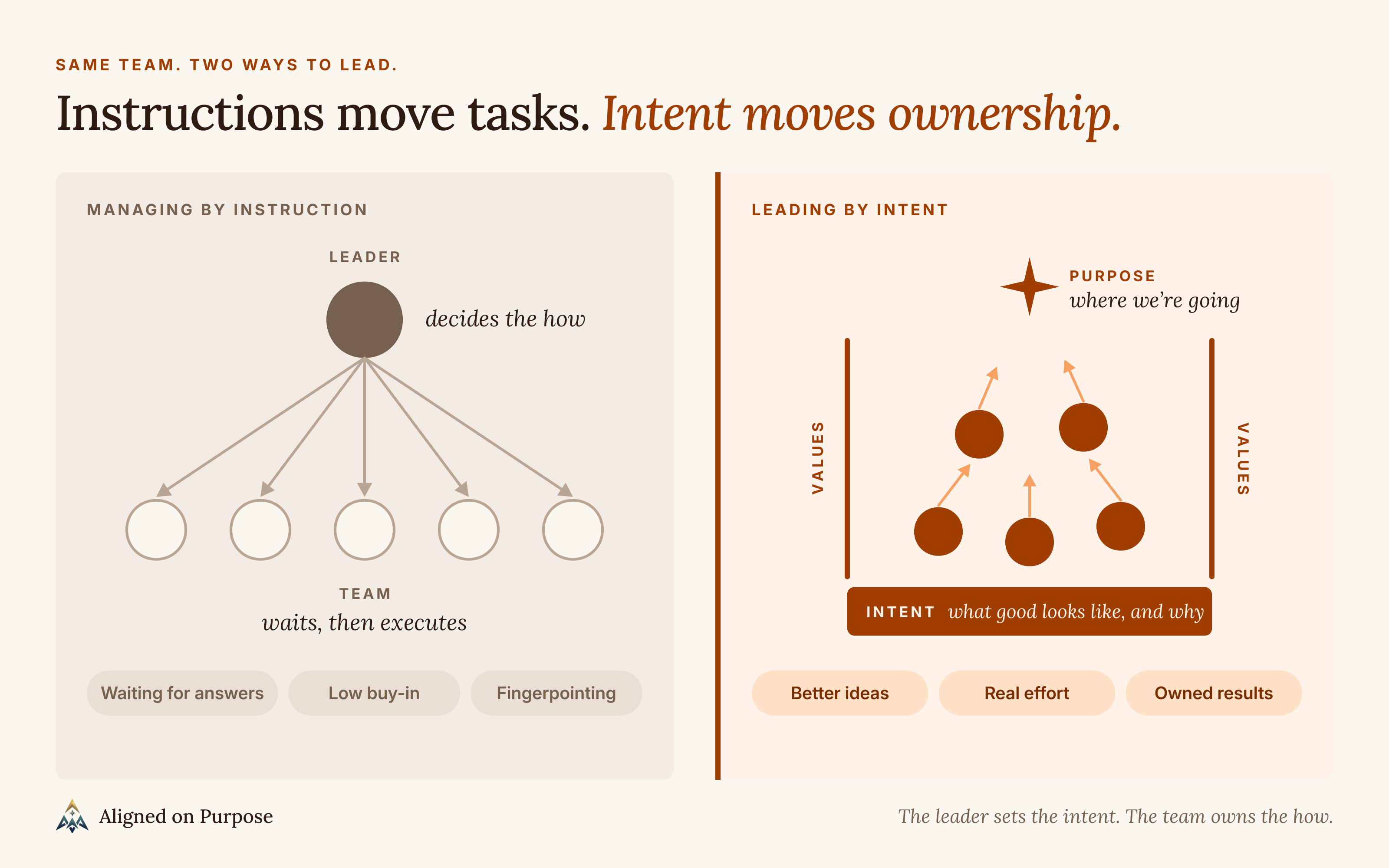
When those three are clear, leaders don’t need to be in every room. People can make real decisions, and those decisions still pull in the same direction.
This is at the heart of our philosophy. We believe business success starts with people, not systems. We believe purpose and values aren’t wall posters. They’re the operating system for how a company decides, prioritizes, and acts. And we believe the founder shouldn’t be the only thing holding the company together. When alignment depends on one person being in every conversation, you haven’t built alignment. You’ve built a bottleneck.
There’s an energy side to this too. In Bruce D. Schneider’s Energy Leadership framework, leadership that runs on control, fear, and blame creates a draining, catabolic environment. Leadership that runs on trust, purpose, and shared values creates a constructive, anabolic one. A leader’s energy is contagious. Control spreads caution. Trust spreads ownership.
Let’s go back to the shipping problem with this lens.
Consider this scenario. The operations lead walks in with late orders. This time the owner doesn’t jump to the fix. Instead: “What do you think is causing it? What do you intend to do?” The lead lays out a plan. The owner asks a couple of questions, checks it against what matters most (keeping promises to customers, treating the warehouse team fairly), and says, “Sounds right. Go for it. Tell me what you learn.”
Maybe the plan isn’t exactly what the owner would have done. That’s okay. The intent is kept. The purpose and values set the boundaries. And now the person closest to the problem owns both the solution and the result.
What happens when people own the solution
When people feel heard and trusted to shape the answer, something shifts.
They bring better ideas, because they’re closest to the work and finally have a reason to share what they see.
They do what it takes, because it’s their plan, and people work harder for their own plans than for someone else’s.
They own the results, good or bad, because you can’t blame someone else for a decision you made yourself.
This isn’t about leaders stepping back and hoping for the best. It’s a different kind of leadership work: setting clear intent, keeping purpose and values alive in everyday decisions, asking more than telling, and creating a culture where disagreeing is safe and welcome.
That work is harder than giving orders, at least at first. But it scales. Giving orders doesn’t.
The business case: this isn’t soft stuff
It’s easy to file all this under “nice to have.” The data says otherwise.
Gallup’s long-running research on engagement has found that business units with highly engaged teams are meaningfully more profitable and productive, with far lower turnover, than those with disengaged teams. And one of the strongest drivers of engagement is whether people feel their opinions count at work.
That last part matters. “My opinion counts” is exactly what leading by intent creates, and exactly what leading by instruction takes away.
For a company with 10 to 50 people, this isn’t abstract. Every disengaged person is a real share of your capacity. Every quiet idea is an opportunity you never get to see. Every decision stuck waiting on the owner slows the whole company down.
A few places to start
You don’t have to change everything at once. Try one or two of these in your next leadership meeting:
- Swap “here’s what to do” for “what do you intend to do?” Then listen before you respond.
- Share the why, not just the what. Intent without context is just a softer instruction.
- Name your guardrails. Make sure your team knows which values are non-negotiable, so they know where their freedom begins and ends.
- Let the person who raises the problem propose the first solution. Your job is to ask good questions, not to race them to the answer.
- Make disagreement safe. Thank people for pushing back, especially when they’re right and you weren’t.
Great companies are built by aligned people, not by one person who knows best
The companies that grow well through their growing pains have something in common. Their leaders stop trying to be the smartest person in the room and start building rooms full of people who think, care, and act like owners.
Those people are engaged because they’re heard. They’re aligned because they share a purpose they believe in. They show up with the company’s values in how they work. And they’re all aiming at the same vision, not because someone told them to, but because they chose to.
That’s what great leadership creates. And that’s what makes a company thrive.
If your team isn’t taking ownership, the most useful question isn’t “what’s wrong with them?” It’s “where am I holding on, and what would happen if I let go?”
The Aligned On Purpose Team