
You Think 'Customer First' Is Your Core Value? What If It's Not a Value at All?
Most companies proudly display their core values on the wall. Integrity. Innovation. Customer First. But what if the majority of those words aren't values at all, just strategies, goals, and aspirations dressed up in noble language? A business coach breaks down what a core value actually is, how to tell the real ones from the imposters, and why the difference matters more than you think.

Your Core Values Are Probably Not Values
And that’s exactly why your values aren’t working.
I’ve lost count of how many conference rooms I’ve walked into where a leadership team proudly points to a wall. Framed. Printed on glossy paper. Sometimes even etched into glass.
Integrity. Innovation. Teamwork. Customer First. Excellence.
And every single time, I ask the same question: “Can you tell me about a time one of these cost you something?”
Silence.
Not awkward silence. Thinking silence. The kind where people realize they’ve never actually been tested on these words. They picked them in an offsite. Maybe a consultant helped. Maybe they voted. The words felt right. They sounded professional. They looked great on the website.
But here’s the thing I keep seeing, over and over, across industries, across company sizes, across continents: most of what companies call “core values” aren’t values at all. They’re strategies wearing a values costume. Goals dressed up in noble language. Behaviors masquerading as beliefs.
And that’s not a small problem. It’s the reason values initiatives die quietly. It’s the reason employees roll their eyes at the poster in the break room. It’s the reason leaders make decisions that contradict their own stated values and nobody even notices, because those words were never real commitments in the first place.
So let’s fix that. Let’s talk about what a value actually is.
A Value Is Not What You Think It Is
A core value is not what you want to achieve. It’s not how you compete. It’s not what’s currently important to the business.
A core value is a deeply held belief about what is inherently important and worth protecting, regardless of the situation or outcome.
Read that last part again. Regardless of the situation or outcome.
That’s the whole game. If you’re willing to abandon it when things get hard, when the quarter is rough, when the client is big enough, when the shortcut is tempting, it was never a value. It was a preference.
Here’s how I think about it: a core value is the principle you refuse to violate, even when violating it would produce a better short-term result.
The Acid Test
I’ve reduced it to one question, and it cuts through the noise every time:
Would you still choose this if it cost you money, success, popularity, or convenience?
If yes, you’re probably looking at a value.
If no, you’re looking at a strategy.
Let me make this concrete. Take “Customer First.” Sounds like a value, right? Every company loves it. But ask yourself this: would you refund a customer who verbally abused your staff? Would you keep bending over backward for a client who treats your people like garbage?
Probably not. And you shouldn’t.
So “Customer First” isn’t absolute. It’s not a value. It’s a priority, and priorities shift depending on the situation. The underlying value might be respect, or service, or human dignity. Those remain valid while you balance competing interests. “Customer First” breaks the moment two good things conflict.
The Confusion That’s Everywhere
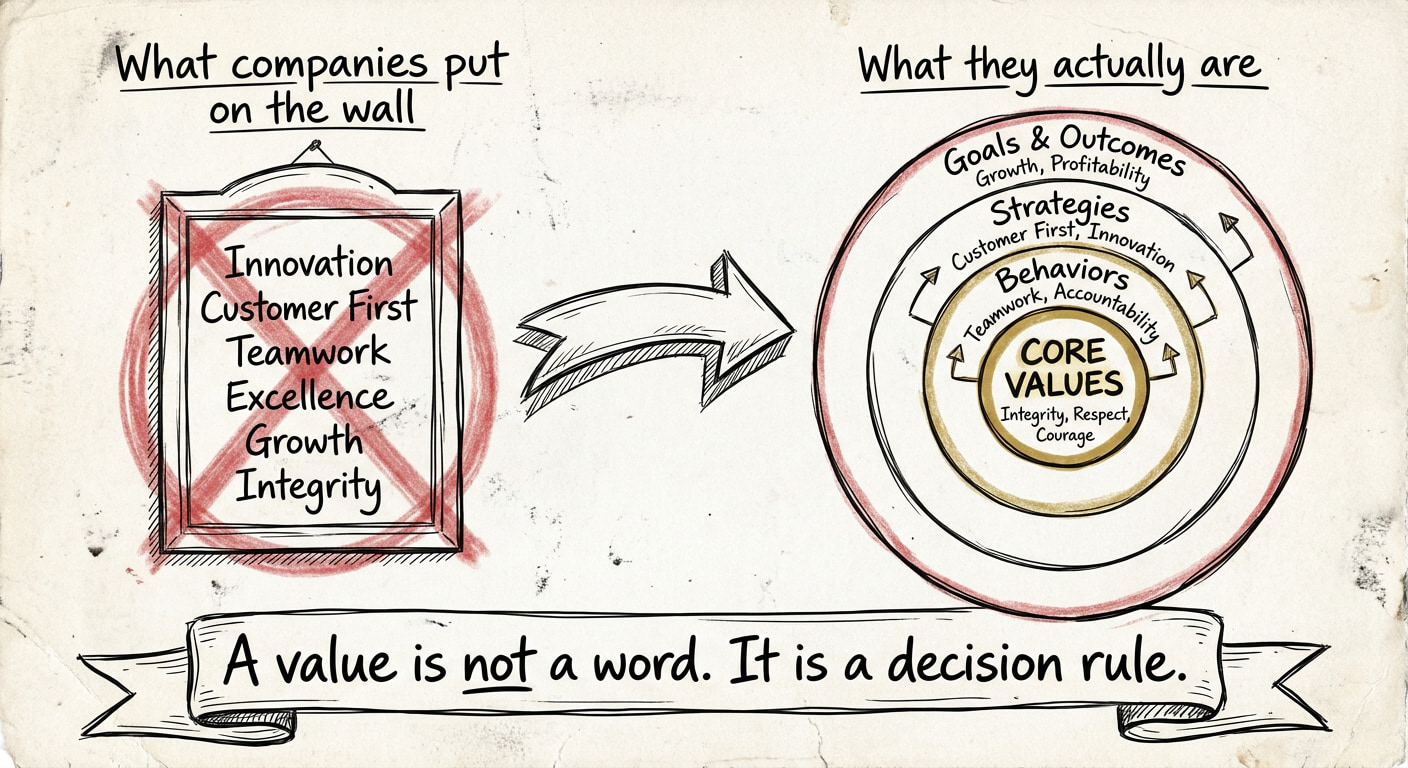
Here’s what I see on company walls and websites all the time, and what those words actually are:
Integrity, Honesty, Respect, Compassion, Courage: these are core values. They describe beliefs about what is inherently right. You’d keep them even if they cost you.
Customer First: a strategy or priority. Teamwork: an operating principle or behavior. Innovation: a capability or strategic approach. Growth: a goal. Profitability: an outcome. Speed: a strategy. Market Leadership: an objective.
Then there are the tricky ones. Excellence and Quality can genuinely be core values if you’d choose doing things right over profit, speed, or hitting a deadline because you believe it’s inherently important to produce work you’re proud of. But for a lot of organizations, they’re just performance standards, nice words that get overridden the moment the pressure is on. The same word can be a deep belief for one company and a slogan for another.
Accountability is similarly borderline. It depends entirely on what you mean by it and how deep the commitment runs.
Most companies mash all of these together into one list and call them “values.” That’s like putting your grocery list, your bucket list, and your wedding vows on the same piece of paper and calling it your identity.
Three Ways to Tell the Difference
If you’re not sure whether something is a real value or something else, here are the tests I use with every client.
The “Why?” Test
Take any phrase and keep asking “Why is that important?” until you hit bedrock.
Customer First. Why? Because customers pay us. That’s not a value. Why else? Because serving people matters. Getting warmer. Why? Because every person deserves to be treated with dignity.
Now you’ve arrived at a value. “Customer First” was just the implementation. Dignity was the belief underneath.
The Identity Test
Ask two questions: “Who are we?” versus “How do we operate?”
Core values answer the first one. Everything else answers the second.
“We collaborate across departments” — that’s how. “We believe every person deserves respect” — that’s who. See the difference?
The Trade-Off Test
This might be the strongest one. Values only become visible when two good things conflict.
You can hit your quarterly targets, or you can tell the whole truth. If honesty wins, honesty is a value. If profit wins, profit was the real value all along. You just didn’t want to say it out loud.
Values reveal themselves in sacrifice. Not in slogans.
The One Thing I’d Change in Every Company
Most companies stop at naming values. One word. Maybe two. Printed on a wall.
That’s where they go wrong.
A value is not a word. It is a decision rule.
Instead of just writing Integrity, write: “We tell the truth even when it costs us.”
Instead of Respect, write: “Every person deserves dignity, regardless of title, status, or disagreement.”
Instead of Courage, write: “We choose the right action over the comfortable one.”
Now those are actionable. Now someone in a meeting can point to them and say, “This decision doesn’t line up.” Now they mean something. One word on a wall is decoration. A decision rule is a commitment.
So What?
If you’ve read this far and you’re feeling a little uncomfortable about the list on your own wall, good. That discomfort is the beginning of honesty.
Most organizations don’t have a values problem. They have a clarity problem. They’ve mixed together beliefs, goals, strategies, behaviors, and aspirations into one list and hoped it would create culture. It won’t. Culture is created by what you actually do when no one is watching and when doing the right thing is expensive.
The words on the wall only matter if they describe that.
Next time, I’m going to tackle a harder question: how do you know the values you picked are actually yours? Because here’s a dirty little secret that nobody talks about at leadership offsites: most companies don’t discover their values. They shop for them. They pick words they admire, words that sound good, words they’ve seen on the walls of companies they respect. But admiration is not identity. The values you chose might say more about who you wish you were than who you actually are. And that gap? That’s where trust goes to die.
Stay tuned.