
You Built the Perfect System. Why Is Everyone Still Checked Out?
Every company running a solid operating system eventually asks the same question: we're doing everything right, so why does it feel like we're just going through the motions? The answer is that process without energy is hollow, and energy without process fades: you need both, woven together, or neither works. Drawing on Jim Collins, Gino Wickman's own evolution, and a real client story, this post shows what it actually takes to build a team that executes and cares.

If discipline were enough, every company running EOS would be thriving. They’re not. Here’s what’s missing.
I am a big fond of EOS as a small business operating system, don’t get me wrong - it is an excellent system! A few months ago, I talked to a good friend, a business owner that had been running EOS for about two years by now. Textbook implementation. Level 10 meetings every week, Rocks set every quarter, Accountability Chart on the wall, Scorecard tracked religiously.
And my friend looked at me and said:
“We’re doing everything right. So why does it feel like we’re just going through the motions?”
Honestly - he is not alone. In my coaching sessions with clients I hear some version of this every few weeks. Different company, different framework, same emptiness.
Then there’s the other version. The founder who leads with heart. Her team loves her and she would do everything for them. The energy is incredible. People feel inspired, connected, purposeful.
But… nothing gets done on time. Priorities shift every week. Meetings are great conversations that produce no outcomes. There’s passion everywhere and execution nowhere.
Two companies. Two opposite problems. Same root cause.
They each have half of what they need.
The Trap Nobody Talks About
Here’s what I’ve come to believe after years of coaching leadership teams:
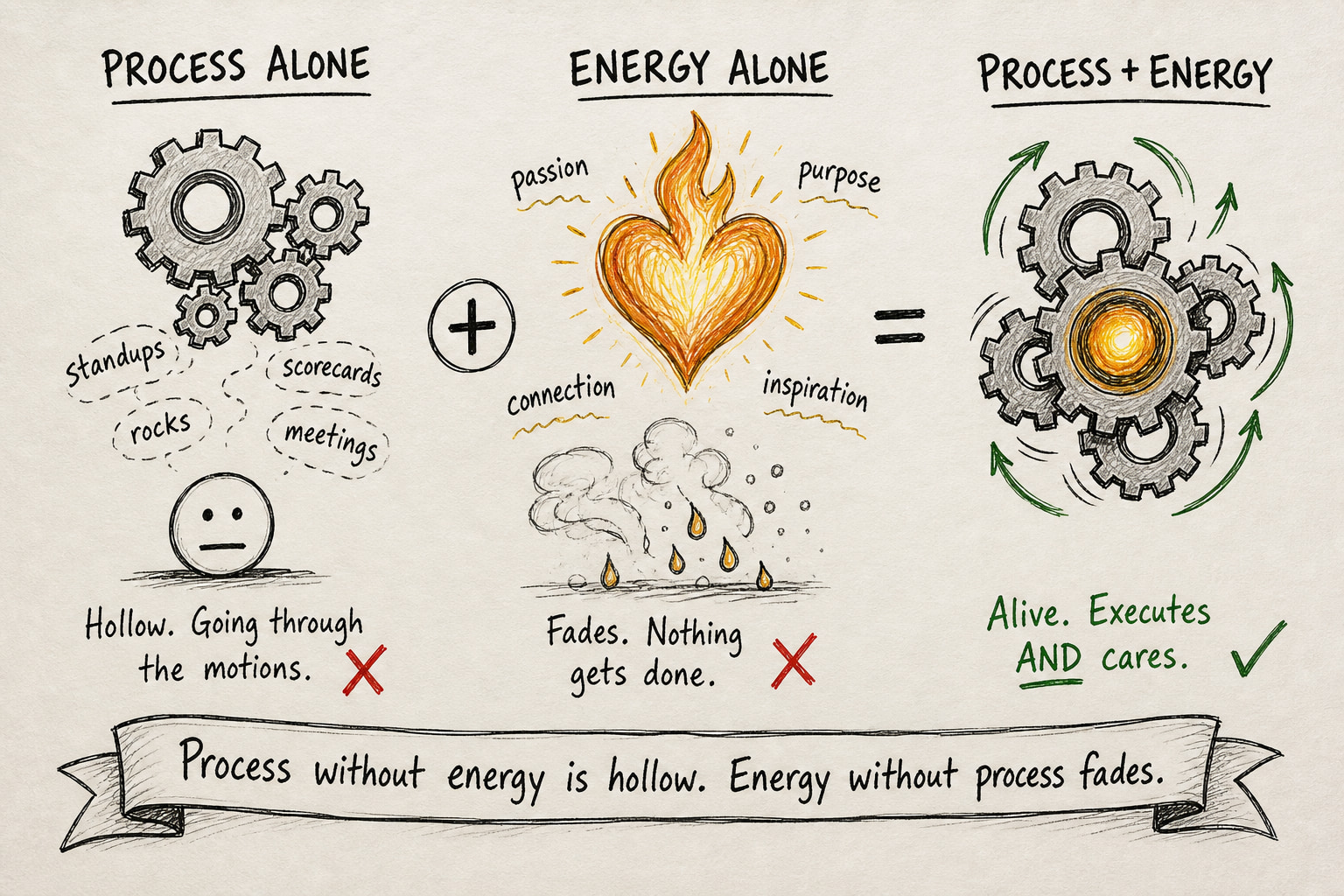
Process without energy is hollow. Energy without process fades.
And almost every approach to running a company picks one side and ignores the other.
The process side has powerful advocates. Gino Wickman built EOS, and over 250,000 companies worldwide adopted it. For good reason: EOS provides real execution discipline. Quarterly goals, weekly meetings, accountability charts, a structured way to identify and solve issues. It works. I borrow from it. I respect it deeply.
But EOS, by design, is light on the human dimension. It doesn’t start with the deeper question of why the company exists or what it truly values at its core. It gives you a structure for alignment, but not the foundational work of making people actually care about what they’re aligning around.
Note: I give EOS as an example because I use it for my own coaching, but eMyth, Scaling Up or other process-based frameworks have the same outcome.
You can run a disciplined cadence and still feel disconnected from meaning.
The energy side has advocates too. Leadership coaching, culture programs, team-building, mindset work. These go deep on the human dimension: self-awareness, values, energy, purpose, personal growth. A skilled coach can unlock profound clarity.
But coaching typically stays between sessions. When the coach leaves the room, nothing in the operating system sustains what was discovered. The insight fades. The urgency of Monday morning wins.
Process gives you the container. Energy gives you the fuel. A container without fuel sits there. Fuel without a container spills everywhere.
The Thinkers Who Got Here First
This isn’t a new idea. The most respected minds in business have been circling it for decades.
Jim Collins, in Built to Last, coined the phrase “the Genius of the AND.” Great companies, he found, don’t choose between seemingly opposing forces. They hold both at the same time. Creativity AND discipline. Stability AND progress. Humility AND fierce determination. Passion AND rigor.
In BE 2.0, Collins went further. He wrote that great performance is about “1% vision and 99% alignment,” and warned that executives spend too much time crafting vision statements and too little time aligning their organizations with the values already in place.
But alignment, in Collins’ framework, isn’t just mechanical. It’s a culture of discipline combined with an ethic of entrepreneurship. When you blend those two forces together, he wrote, you get:
“A magical alchemy of superior performance and sustained results.”
Read that again. Culture of discipline. Not just discipline. Culture. That’s the energy. The human side. The part that makes people want to show up and do the hard work because they believe in what they’re building.
And then there’s Wickman himself.
After spending decades building the ultimate process system, after 2,000 sessions with 135 companies, after EOS became a global phenomenon, what did he do next?
He wrote Shine.
A book about energy. About the inner world. About the 10 Disciplines for maximizing your energy, impact, and inner peace. About how driven leaders burn out not because they lack systems but because they’re “running on tension instead of peace.”
His own evolution is the proof: the man who built the most widely adopted business operating system in the world looked at what was missing and said, “It’s the human side.”
That’s not a coincidence. That’s a pattern.
What It Actually Looks Like When It Breaks
Let me tell you a story from a client engagement. Names changed, details altered, but the pattern is real.
A 22-person logistics software company was in trouble. Their biggest client, 38% of revenue, had issued a 90-day ultimatum: fix the recurring integration failures or we leave.
The COO did exactly what you’d expect. He stood up a structured incident response: root cause analysis, a cross-functional team, daily standups, a shared board tracking every defect. Textbook. The right move.
By day 12, the team was imploding.
The lead engineer, Sarah, had built the original integration. She heard the client’s complaints as a personal indictment. She went into victim mode: withdrawn in standups, defensive when questioned, working 14-hour days alone, refusing to collaborate. Her work was getting sloppy.
The account manager, Marcus, was furious at engineering for “putting him in this position.” He was making cutting remarks in Slack, escalating minor disagreements, poisoning every interaction. The client could feel the tension on check-in calls.
Two junior developers had stopped contributing ideas entirely. They read the room and shut down.
The process was running perfectly. The board showed tasks “in progress.” The standups happened on schedule. And none of it was working, because the people inside the process were checked out, afraid, or angry (in Energy Leadership terms we call it Level 1 and level 2 - this is a bad place for creativity and engagement).
Now imagine the opposite. Imagine the CEO had skipped the process entirely and just pulled people aside for heart-to-hearts. Empathy. Understanding. Great conversations.
Meanwhile, the client sees no tangible progress, no system, no evidence that anything is actually getting fixed. Good intentions, no delivery.
Then a coaching session happened. That predated our system, yet EOS and iPEC Energy Leadership were the core of my coaching even back then. What actually happened was the magic when integrating both process and energy.
On day 14, the CEO paused the standup and asked each person to say one thing that was weighing on them. No solutions. No responses. Just say it.
Sarah said quietly:
“I feel like everyone thinks I’m incompetent.”
The room went still.
The CEO didn’t try to fix it. She said: “Thank you. That took guts.” Then she turned to Marcus. He admitted he was terrified of losing his biggest account, and his fear was coming out as blame.
Then she did the critical thing: she reconnected the emotions to the process.
She told Sarah that she was leading the fix not as punishment but because she was the best person for it, and the process they’d built was designed to make sure she didn’t have to do it alone. She told Marcus his job on the client call was to narrate the board, to show the system working, because that’s what rebuilds trust.
She added a 60-second energy check to the start of every standup. Green, yellow, red. No explanation required. Just a signal. When Sarah flagged yellow two days later, her partner simply said “want to walk through it together?” instead of waiting for a code review to surface the confusion.
They delivered the full fix in 71 days. The client renewed for two years at a higher tier.
On the renewal call, the client VP said something telling:
“It wasn’t just that you fixed the bugs. It was that we could see your team was actually communicating. That gave us confidence it wouldn’t happen again.”
The process was the vehicle. The energy was the fuel. Neither drives without the other.
Why This Keeps Happening
Companies keep falling into this trap because the whole industry has split the answer in two and sold you half.
Strategy consulting gives you a plan that dies on contact with Monday. Operational frameworks give you execution discipline without the deeper “why.” Leadership coaching goes deep on the human dimension but fades between sessions. Culture programs produce beautiful artifacts that live in documents, not in decisions.
Each one addresses a real piece of the puzzle. None of them connect the whole loop.
And here’s what makes it worse: under pressure, which is where alignment matters most, humans don’t rise to the level of their aspirational values. They fall to the level of their emotional conditioning.
When the heat turns up, the standup becomes status theater. The accountability chart becomes a blame map. The quarterly goals become a source of anxiety rather than direction.
That’s not a process failure. It’s an energy failure happening inside a perfectly designed process.
The Integration
So what does it look like when energy and process actually work together?
It looks like a weekly meeting that starts with a human check-in before diving into the scorecard. Not because it’s touchy-feely, but because a team operating from fear will give you different answers than a team operating from honesty.
It looks like an issue resolution process that doesn’t just ask “what’s the root cause?” but also “what assumption is driving this?” and “what are we afraid of that we’re not saying?”
It looks like a strategy that’s evaluated not just for alignment with your values, but for the energy behind it. Is this strategy born from opportunity and purpose, or is it a fear-based reaction to a competitor? Both might look identical on paper. They’ll produce very different results.
It looks like leaders who understand that their own energy is contagious. That the emotional state of the CEO sets the ceiling for the entire organization. That you can’t build a high-trust, high-ownership culture while you’re operating from anxiety and control.
Collins called it the Genius of the AND.
Wickman lived it by evolving from pure process to energy-aware leadership.
Bruce Schneider, the founder of iPEC, built an entire framework around it: seven levels of energy, from catabolic (draining, fear-based, destructive) to anabolic (constructive, creative, purpose-driven), showing that the energy behind your actions determines their quality more than the actions themselves.
The answer isn’t process OR energy. It’s process AND energy, woven together so tightly that you can’t tell where one ends and the other begins.
The One Question That Changes Everything
If I could leave you with one question to take into your next leadership meeting, it would be this:
“Is our system getting honest input from our people, or is it getting performed compliance?”
If your standups feel like status theater, your team has a process but no energy.
If your team has great conversations but nothing changes, you have energy but no process.
The companies that break through are the ones that refuse to choose. They build the discipline and they fuel it with genuine human engagement. They create the container and they fill it with purpose. They run the system and they make sure the people inside it actually care.
That’s not soft. That’s the hardest thing in business.
And it’s the only thing that actually works.