
Stop Shopping for Who You Wish You Were: How to Excavate and Prove Your Real Core Values
Most companies don’t discover their core values—they shop for them. In this sequel, we run the brutal Acid Test to separate real beliefs from strategic priorities, share how early-stage startups can align around founder values, and break down how to transform flat words into actionable decision rules that guide your team when the pressure is on.
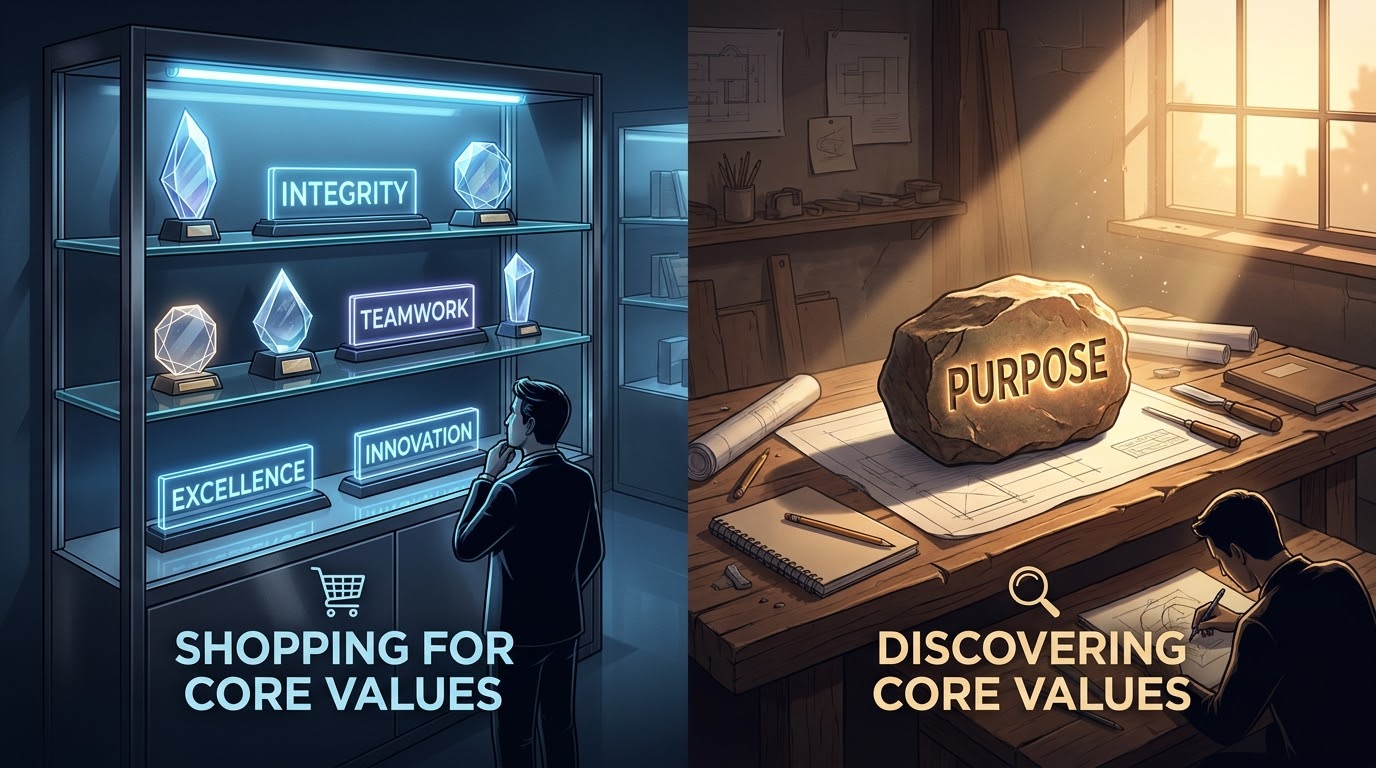
If you read my last piece, you might remember the cliffhanger I left you on: most companies don’t discover their values—they shop for them. They pick polished, high-minded words they admire, slap them on a glossy poster, and hope a vibrant company culture magically appears.
But let’s be hones with ourselves: admiration is not identity.
It reminds me of a founder, a very nice gentleman I coached recently—let’s call him David. David ran a software engineering firm in a very unique niche of the pharma industry, that was hitting a painful scaling wall. His team was stressed, and internal friction was mounting. When I asked to see his core values, he pointed proudly to a banner in the hallway that read “Uncompromising Boldness.” He explained that he deeply admired fast-moving, market-disrupting giants and wanted his team to embody that same aggressive spirit.
But when we sat down to analyze his hardest business decisions over the past three years, we unearthed a completely different story.
We found that David had actually fired their highest-paying client because that client kept demanding rushed, sloppy code overrides. David chose safety, precision, and architectural stability over speed and massive revenue every single time.
David’s company didn’t value “Uncompromising Boldness.” They valued Uncompromising Quality—but David was too busy shopping for values he admired to see the quiet, honest truth of who his company actually was. By putting a beautiful lie on the wall, he had created an alignment gap —leaving his team deeply confused because their daily reality contradicted the placard in the lobby. That gap is where trust goes to die.
Let’s talk about how to stop shopping and start excavating the real thing.
1. The Acid Test: Is It a Value or Just a Strategy?
A real core value isn’t a goal you’re chasing, an operational strategy, or a performance standard.
A core value is a deeply held belief about what is inherently important and worth protecting, regardless of the situation or outcome.
It is the uncompromising principle you refuse to sacrifice, even when violating it would give you a massive short-term win. To help my clients cut through the aspirational noise, I use one brutal question that acts as an Acid Test:
Would you still choose this if it cost you money, success, popularity, or convenience?
If you answer yes, you’ve likely found a core value. If the answer is no, you’re looking at a strategy, a priority, or a performance standard.
Take another corporate classic: “Customer First.” It sounds noble, but run it through the test. Would you stand behind a client who verbally abuses your frontline team? Would you bend over backward for a customer who treats your employees like garbage?
No, you wouldn’t—and you shouldn’t.
That means “Customer First” isn’t absolute. It is a priority that you balance against other needs, not a core belief. [32] The true value underneath is likely Respect or Human Dignity, which remains completely intact even when you fire a toxic client.
When you mix goals, strategies, and deep-seated beliefs on the same poster, it is like putting your weekly grocery list, your retirement bucket list, and your marriage vows on the same piece of paper and calling it your identity.
| True Core Values | Strategies, Priorities & Outcomes |
|---|---|
| Integrity, \n\nHonesty, \n\nRespect, \n\nCompassion, \n\nCourage\n\n(Beliefs about what is inherently right; you keep them even when they cost you)* | Customer First (Strategy / Priority)\n\nTeamwork (Operating Principle / Behavior)\n\nInnovation (Capability / Strategic Approach) \n\nGrowth (Goal) \n\nProfitability (Outcome)\n\nSpeed (Strategy) |
2. No History? No Problem. (A Guide for Early-Stage Startups)
One objection I hear constantly from early-stage founders is: “We don’t have a history yet. We haven’t been through major crises, ‘peak experiences,’ or hard ‘decision autopsies’ to look back on. How are we supposed to discover our values?”
If you are a young startup, you can’t discover values based on a non-existent corporate history. Instead, you must look directly at the founders’ personal values.
At this early stage, the company’s culture is a direct projection of its founders. The personal values of the founding team will naturally shape how the company hires, fires, makes deals, and communicates.
- If a founder deeply values Autonomy, the company’s operating system will naturally lean toward decentralized decisions and flexible hours.
- If a founder values Security and Precision, the culture will naturally emphasize strict quality controls and thorough processes.
For startup teams, this isn’t a branding exercise—it is the ultimate indicator of alignment vs. conflict. If co-founders do not explicitly unpack, challenge, and align their personal values early on, those unstated differences will eventually collide when the business hits its first major scaling bottleneck or cash-flow crisis.
3. Beyond Words: How to Turn a “Value Word” Into a Decision Rule
Most companies make the mistake of leaving their values as bare, single words: Diversity, Integrity, Excellence. [8, 37]
But a single word is just wall decoration. To make it operational, a value must become a decision rule. [37]
In the Aligned On Purpose methodology, we unpack every single core value into three distinct, structured layers: Name, Meaning, and Implementation. [8, 25]
Let’s take a common word like “Diversity” and transform it from a corporate buzzword into an active decision-making filter:
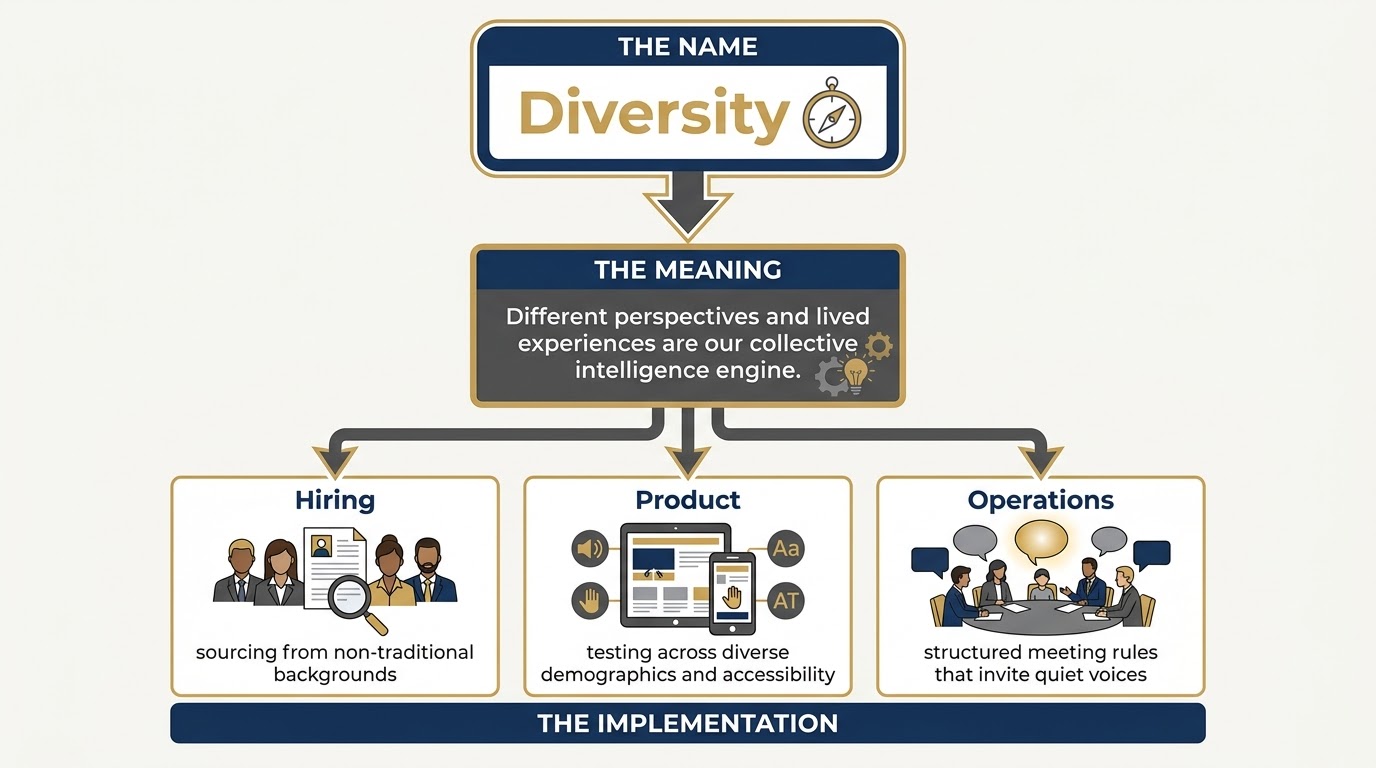
The Three-Layer Transformation:
-
The Name: Diversity
-
The Meaning (What does this actually mean to our organization?):“We believe that different perspectives and lived experiences are not checkboxes to tick, but the actual source of our collective intelligence and creative problem-solving.”
-
The Implementation (How do we put this into practice across our business aspects?):
- In Hiring: “We design our recruiting pipeline to source from non-traditional backgrounds, actively choosing to wait longer for the right candidate rather than taking the easy, homogeneous route.”
- In Product Design: “We mandate user testing with diverse accessibility and demographic groups before any feature is approved, ensuring empathy is built directly into our product’s code.”
- In Operations & Meetings: “We structure our leadership meetings so that dissenting opinions are explicitly invited, and we round-robin key decisions so the loudest voice never dominates.”
Look at what we did. We took a vague, easily ignored word and transformed it into a set of uncompromising decision rules. If a manager tries to rush a hire by skipping diverse sourcing, or if a product is launched without broad accessibility testing, anyone on the team can point to the Foundation and say: “This decision doesn’t align.”
4. The Six-Phase Core Values Journey
True core values are not invented; they are excavated. At Aligned On Purpose, we guide leadership teams through a rigorous, Six-Phase Core Values Journey to ensure their Foundation is built on absolute truth, not aspirational shopping.
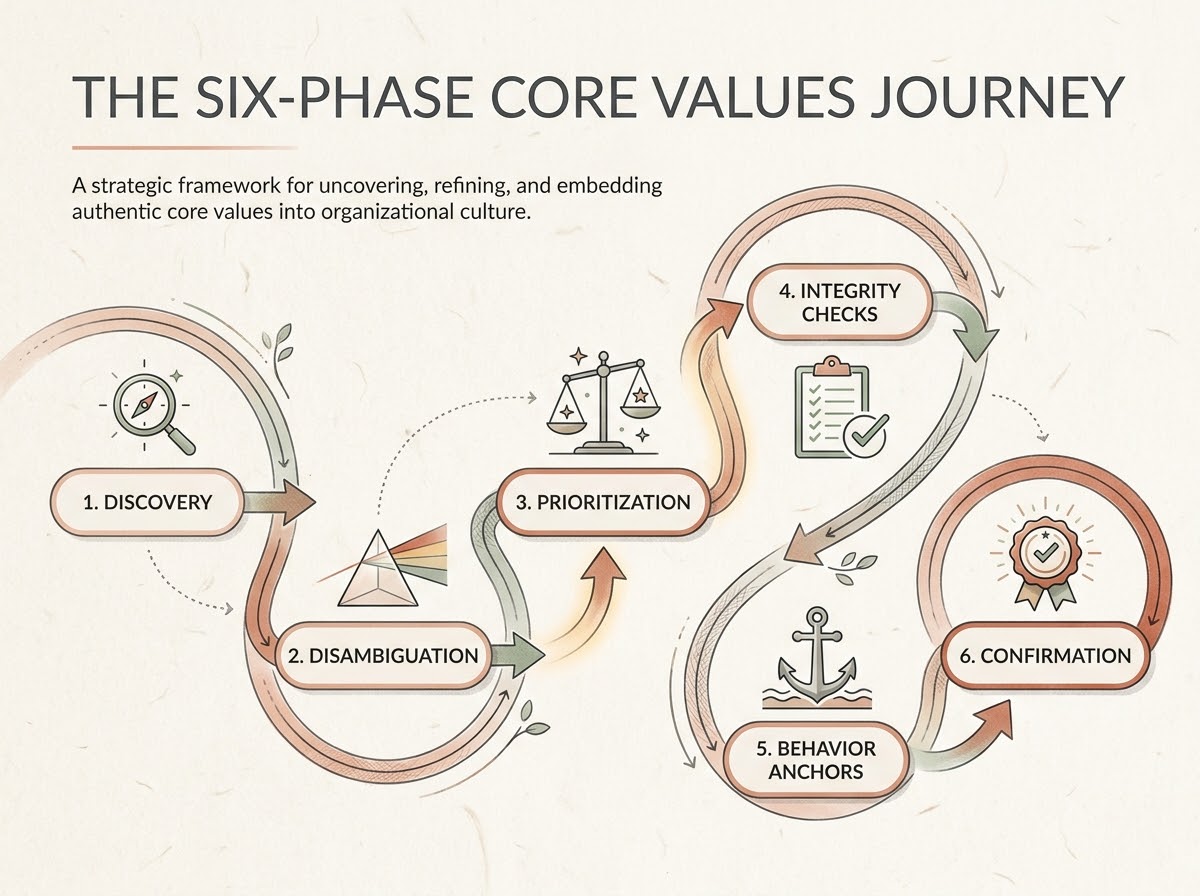
Here is how the methodology works:
- Discovery (The Evidence): We gather raw, objective evidence from your actual business history. We analyze peak experiences (when the team felt most alive and aligned), admiration mapping (examining who you look up to and the exact reasons why), and decision autopsies (analyzing your hardest past choices and what you sacrificed to make them).
- Disambiguation: We filter out the imposters. We separate actual core values from strategies, goals, and basic performance standards, redefining the remaining concepts in your team’s own authentic words.
- Prioritization: A healthy organization cannot focus on ten different things. We slice the list down to a tight, high-impact set of three to seven core values. If everything is a value, nothing is.
- Integrity Checks: We run your selected values through five brutal authenticity tests, starting with the Trade-Off Test: Would you keep this value if it cost you client relationships, short-term profit, or operational convenience?
- Behavior Anchors: We translate the validated values into concrete, everyday behaviors and—crucially—identify the early red flags that signal you are drifting away from them.
- Confirmation: We transition these values from a workshop exercise into your live company operating system, validating them against real-world, real-time daily operational decisions.
The Verdict: Stop Shopping. Start Excavating.
If this article makes you look at your company’s wall placard with a bit of skepticism, good. That discomfort is where alignment begins.
Your company doesn’t need prettier posters. It needs clear, operational commitment. It needs values that serve as an active decision-making filter when Monday morning hits and the pressure is on.
To help your team move past “shopping” and start doing the hard, rewarding work of excavation, we have developed an interactive, step-by-step guidance prompt based on this exact methodology.
👉 Get started today and download our custom Discovery & Disambiguation Prompt here: alignedonpurpose.ai/resources/
Grounding & Sources
This article is grounded in the Aligned On Purpose (AOP) organizational alignment methodology, which turns core purpose, vision, and values into a living operational system.