
"People First" Is the Most Repeated Lie in Business. Here's How to Make It True.
Every company says people come first. Then the quarter gets tight and the truth comes out. Here's what people-first actually looks like on a Tuesday afternoon, what Collins, Wickman, and the research say about it, and why AI makes getting it right more urgent, not less.

“And I want to thank you, personally each and every one of you.” If you attended those AHM (all hands) I bet you heard that too many times, more than you want to count, and you may have never even met the guy. You know the slide. A big stock photo of smiling people and the line: “Our people are our greatest asset.” and a sea of hands clapping and hearts and shooting up your zoom window.
Two weeks later, someone’s 1:1 got cancelled for the third time in a row. The reject note said - a conflict with leadership meeting.. The idea a junior engineer raised in March is still “being looked at.” And the person who carried the release over the weekend finds out about the reorg from a calendar invite titled “Quick sync.”
I’m not throwing stones from far away. I’ve caught myself doing the lite version of this. Rushing a 1:1 because a deadline was screaming. Saying “great job” on my way to something that felt more important. It’s easy. That’s the problem.
So let’s ask the uncomfortable question. Everyone says people come first. Are they? What does it really mean?
The asset problem
Jim Collins put it better than anyone in Good to Great:
“People are not your most important asset. The right people are.”
I’d push it one step further. People aren’t assets at all.
Look at how most companies actually treat them on paper. The laptop is an asset. The person using it is an expense. And what do companies do with expenses when the numbers get tight? They cut them. The language gives us away.
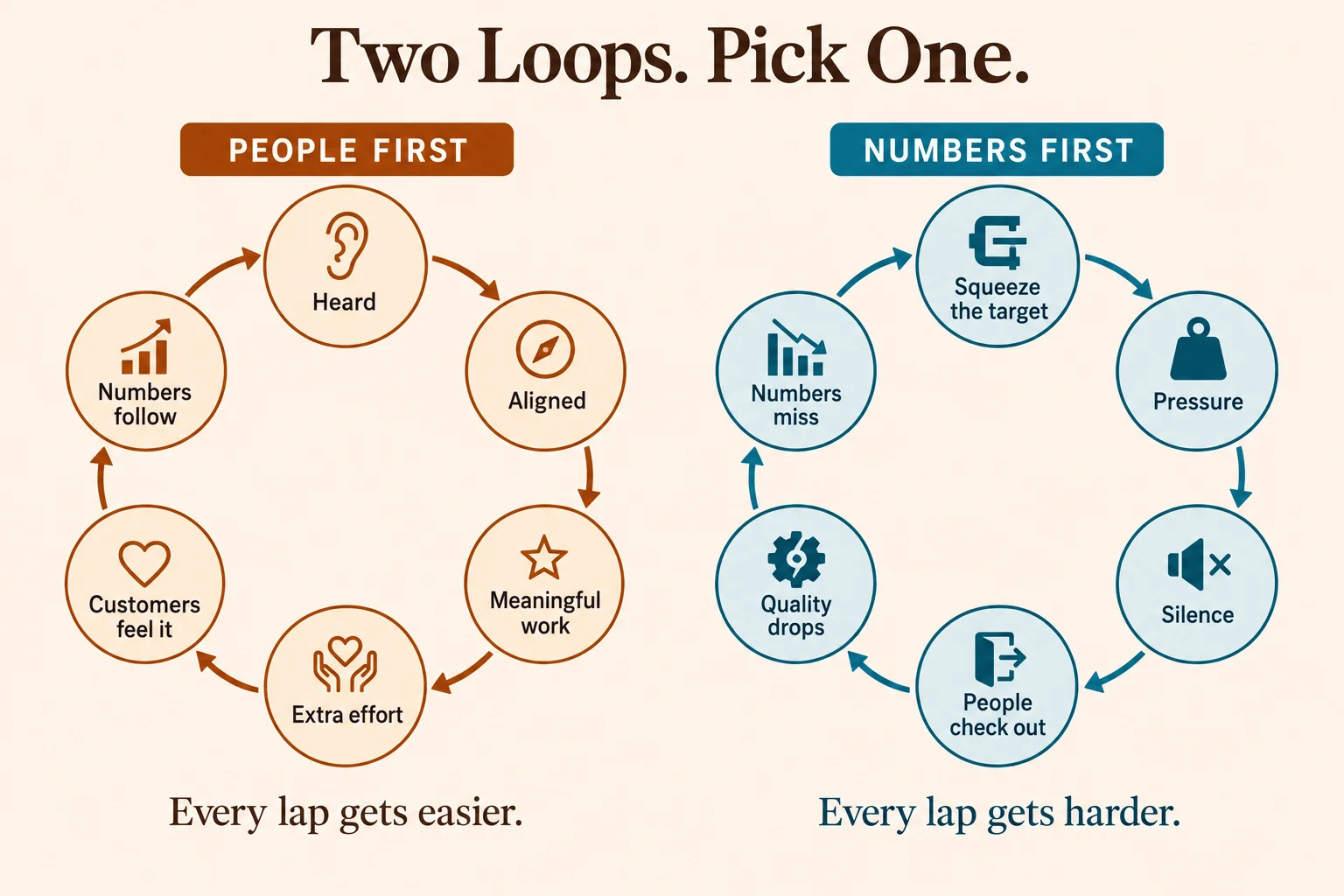
An asset is something you own, use, and depreciate. A person is someone who chooses, every single morning, how much of themselves to bring to work. You can pay for their time. You can’t buy their best ideas, their loyalty, or the extra hour they put in because they actually care. That part is a gift, and it only shows up when people feel three things:
- Heard. Their voice changes something.
- Aligned. They believe in where the company is going and what it stands for.
- That their work matters. It means something, and it fits what they’re good at and love doing.
What the classics actually say
None of this is new. Leadership books have been saying it for decades. We just keep skipping the hard parts.
Collins: First Who, Then What. Great companies got the right people on the bus before they figured out where to drive it. And the part people forget: “if you have the right people on your bus, you don’t need to worry about motivating them. The right people are self-motivated.” His first criteria for a “right person” is that they share your core values. Not that they hit their numbers.
Wickman: Right people, right seats. In EOS, the right people share your core values, and the right seat is one they Get, Want, and have the Capacity for (The GWC concept). In How to Be a Great Boss, Wickman and René Boer list the basics of managing people, and “reward and recognize” and regular one-on-one conversations are right there next to the meetings and scorecards. Their Delegate and Elevate tool is literally about getting people into the work they love and are great at.
Herzberg: Pizza isn’t motivation. Back in 1968, Frederick Herzberg split work factors into two buckets. “Hygiene” factors like pay, perks, and policies make people unhappy when they’re missing, but adding more doesn’t motivate anyone. What actually motivates: achievement, recognition, the work itself, responsibility, and growth. So the free lunch is nice. It just isn’t the point.
Sinek and Chapman: Leaders eat last. When the 2008 recession hit, Barry-Wehmiller saw new equipment orders drop about 40%. CEO Bob Chapman was ready to do what everyone does and lay people off. Instead, everyone in the company took four weeks of unpaid furlough, and they suspended the 401(k) match. His reasoning: “Why not have everyone endure a little pain so that no one had to endure a lot of pain?” Simon Sinek built a big part of Leaders Eat Last around that culture.
Schneider: Your energy is contagious. Bruce D. Schneider’s Energy Leadership work shows that a leader’s energy, draining and fear-driven or constructive and purpose-driven, spreads through a team. You can’t run a catabolic, “hit the number or else” culture and expect anabolic, creative people.
Notice the pattern? Not one of them says “hold a nice all-hands.”
Welcome to people-first theater
Here’s what it looks like when a company claims people first but doesn’t live it. You’ll probably recognize a few. I recognize most.
| People-first theater (once in a while) | People-first practice (every day) |
|---|---|
| Monthly all-hands: “you’re all amazing” | A 1:1 that doesn’t get cancelled, where you mostly listen |
| Annual engagement survey, nothing changes | “You said, we did” within two weeks |
| Values poster in the lobby | Values used to make the hard call, out loud |
| One “Employee of the Year” award | Specific recognition, the same week, for lots of people |
| “We’re a family” (until Q3) | Shared pain when times are tough |
| The brilliant jerk keeps getting promoted | Hiring, promoting, and parting ways based on values |
| AI rollout announced, people find out later | People shape how AI changes their work |
The survey one gets me the most. Asking people what’s wrong and then doing nothing isn’t neutral. It’s worse than not asking, because now you’ve proven their voice doesn’t matter.
What happens when they do (and when they don’t)
This isn’t a feel-good argument. It’s a numbers argument, which is kind of funny.
 When companies don’t:
- Gallup found that only 21% of employees worldwide were engaged in 2024, down from 23%. They estimate that drop cost the global economy $438 billion in lost productivity. The biggest decline was among managers, whose engagement dropped from 30% to 27%. Tired managers make tired teams.
- MIT Sloan researchers looked at attrition during the Great Resignation and found that a toxic culture was 10.4 times more powerful than compensation in predicting a company’s turnover compared with its industry. People didn’t leave for the money. They left the culture.
- In Gallup and Workhuman’s research, 55% of U.S. employees get no recognition at all, or recognition that doesn’t hit any of the qualities that make it meaningful.
When companies do:
- Gallup’s meta-analysis of over 183,000 teams and 3.3 million employees found that top-quartile engaged teams have 23% higher profitability and 78% lower absenteeism than bottom-quartile ones.
- Employees who got high-quality recognition were 45% less likely to have left their company two years later.
- Alex Edmans at London Business School found that the “100 Best Companies to Work For” beat the market by 3.5% a year from 1984 to 2009.
So yes, when people come first, the numbers follow. When you chase the numbers, people check out first and leave later. They just don’t always tell you in between.
AI makes this more urgent, not less
Here’s where it gets tricky. AI is the most powerful numbers-chasing tool we’ve ever had. Why bother with a 1:1 when a dashboard can score “sentiment”? Why have a brainstorm when a model can spit out 50 ideas in ten seconds? Why keep the support team when a chatbot is cheaper?
Klarna tried that last one. In 2024 they said their AI assistant did the work of 700 customer service agents. By May 2025 the CEO was telling Bloomberg they were hiring humans again: “As cost unfortunately seems to have been a too predominant evaluation factor when organizing this, what you end up having is lower quality.”
There’s a line from an old IBM training slide (supposedly from 1979) that’s been going around again, and for good reason:
“A computer can never be held accountable. Therefore a computer must never make a management decision.”
Air Canada learned that the expensive way. Their chatbot gave a grieving customer wrong information about bereavement fares, and the airline argued it wasn’t responsible for what the chatbot said. The tribunal called that “a remarkable submission” and made them pay. You can outsource the typing. You can’t outsource the accountability.
The same goes for innovation and judgment:
- A 2024 study in Science Advances found that AI-generated ideas made individual writers’ stories better, but the stories became more similar to each other. The researchers called it individual creativity “at the risk of losing collective novelty.” Great if you want ten versions of the same idea.
- A 2025 Microsoft Research survey of 319 knowledge workers found that the more people trusted AI, the less critical thinking they applied. More confidence in themselves, more critical thinking.
So here’s my take. Use AI for the legwork, so your people get more time for the stuff only they can do: original ideas, hard calls, owning the outcome, caring about a customer, noticing a colleague is having a rough week. That’s the human advantage. Trade it away for a cheaper cost line and you’ll get exactly what Klarna got.
That’s also how we build Aligned On Purpose. Our AI coach supports a real human coach and never stands in for them. It suggests, a human confirms. It never writes in your voice. Not because AI can’t, but because some things shouldn’t be handed off.
How to actually be people first (starting Monday)
People first isn’t a speech. It’s a daily habit. Here’s what that looks like in practice:
- Protect the 1:1. Weekly or every other week, 30 minutes, their agenda. Talk less than a third of the time. If you cancel it, you’ve told them exactly where they rank.
- Close the loop. When someone raises something, come back within two weeks with “here’s what we did.” If the answer is no, say no and explain why. A clear no beats a polite black hole.
- Recognize specifically and soon. “Great job, team” is background noise. “The way you rewrote the onboarding email cut our support tickets, I noticed” actually lands. Do it the same week, and do it a lot.
- Match people to what energizes them. Ask everyone two questions: what part of your job would you happily do all day, and what part drains you? Then move work around. Wickman’s Delegate and Elevate is a great place to start.
- Hire, promote, and part ways on values. Keeping the high performer who treats people badly tells everyone what you really value. They’re watching.
- Promote from within and say why out loud. Every promotion tells the rest of the team what success looks like here. Make sure it’s what you want.
- Write down your AI line. List the decisions that stay human: hiring, firing, performance reviews, strategy, the call on an angry customer, anything with a person on the other end. AI can research, draft, and summarize. A named human signs off.
- Measure it like it matters. Yes, I see the irony. But put it on the scorecard: 1:1s held, survey items closed, recognition given. Numbers aren’t the enemy. Chasing them instead of people is.
The real test
People first gets tested when it costs you something. When the quarter is tight, the deadline is real, and the easy move is to squeeze. That’s when your team finds out if the poster was true.
You don’t need a better all-hands. You need a hundred small moments where people feel heard, aligned, and like their work matters. Do that every day and the numbers will take care of themselves.
Next all-hands, skip the “each and every one of you” line. Nobody will miss it. They’ll notice the 1:1 you didn’t cancel.