
"Increase Revenue by 20%" Isn't a Goal. It's a Scoreboard
Most leadership teams set goals that are really just targets: what, how much, by when. But a number only tells you whether you won. It doesn't tell you what you're playing for. Here's the aligned view of a goal: intent, strategies, and measures, each with its own conversation, and why keeping them separate keeps your growth true to your purpose.
When we talk to leaders about goals, the immediate formula almost always comes up. Get his value to hit that number by that date.. The y call is a SMART goal.
“Increase revenue by 20% by the end of next quarter.”
Everyone nods. It’s clear, it’s measurable, and it has a deadline. It checks every box we were taught a good goal should check.
Fast forward three months… the team is stressed, a few corners have quietly been cut, and nobody can quite explain how hitting (or missing) that number moved the company closer to what it said it wanted to become. But hey - we have a number to reach.
So let’s ask the uncomfortable question: is “increase revenue by 20%” really a goal? Or is it the result we hope a good goal will produce?
A Number Tells You If You Won. Not how to play.
There’s nothing wrong with the number. Revenue matters. Targets matter. The problem is when the target is the whole goal.
Strategy thinker Richard Rumelt has watched this happen for decades. In a piece published by McKinsey, he describes a leadership retreat where the strategy came down to financial targets: 15% earnings growth, 15% return on equity. Business unit leaders then built their “strategies” around hitting those numbers. Meanwhile the real challenges (technology falling behind competitors, a slow engineering group) never got a serious conversation. In the years after, the company lost about 30% of its market share.
His conclusion is blunt. Strategy:
“…is not a financial goal, or a plan for hitting a financial goal, or a wished-for end state.”
Because when the number is the goal, the conversation jumps straight to how do we hit it? And it skips the most important question: what are we actually trying to make possible?
The real question: not “did we hit the number?” but “did hitting it move us closer to where we want to go? or even deeper: “Are we closer to who we said we’d become?”
Start Higher: Your Vision Is Your Purpose and Values, Pointed Forward
To set an aligned goal, we have to start above the goal.
In our methodology, a company’s vision grows out of two things: its purpose (why we exist, beyond making money) and its values (how we believe we should operate). Vision is where those two point us in the future. On other words - if we pursue our purpose by demonstrating out value, how would the world look like?
Jim Collins describes vision in a similar way: an organization’s purpose beyond making money, its timeless core values, and bold aspirations for its future. And he adds a warning worth taping to the wall of every planning room:
“There is a big difference between being an organization with a vision statement and becoming a truly visionary organization.”
The difference, he argues, is alignment: translating purpose and values into concrete mechanisms. Goals are one of the most important of those mechanisms. A goal should move us closer to the vision. If it doesn’t, it’s just activity with a deadline.
The Aligned View: A Goal Has Three Parts
Let’s visualize it with a simple example.
Picture a pizza place. Its purpose isn’t pizza. Its purpose is to create a happy place where families come together and have fun. Pizza is just how they get through the door. The play tables, the music, the drawing kits, the way the staff greets a tired parent: that’s the business.
Now let’s build a goal the aligned way, in three separate parts.
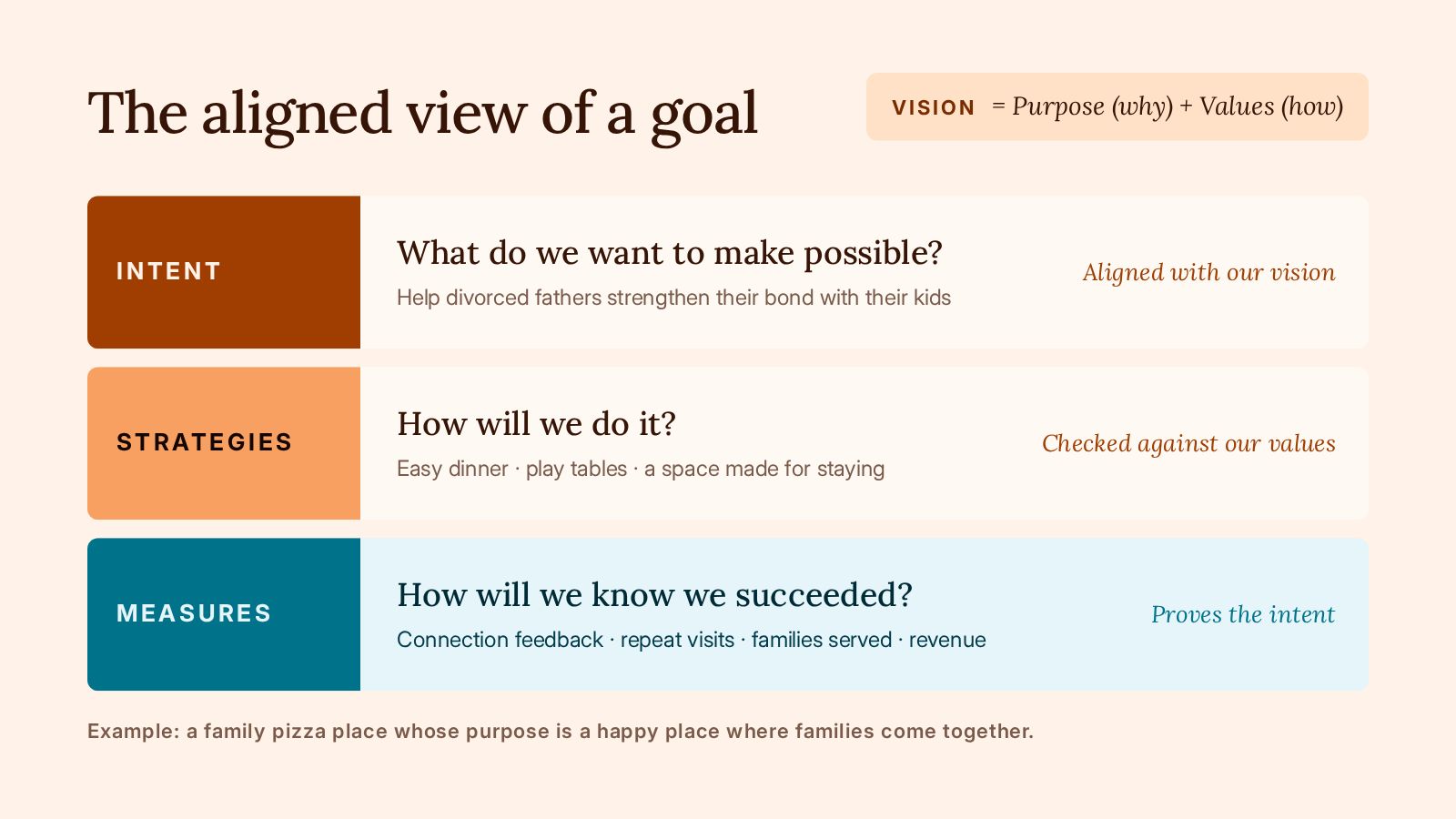
Part 1: Intent (what we want to make possible)
The intent answers one question: what do we want to make possible, and how does it move us toward our vision?
For our pizza place:
Intent: Help divorced fathers strengthen their bond with their kids during visitation time.
Notice what’s not there. No number. No date. No tactics. Just a clear, meaningful contribution that connects directly to the purpose. Anyone on the team can read it and understand why this matters.

Part 2: Strategies (how we’ll do it, true to our values)
Strategies go one layer deeper and answer: how will we make the intent real, in a way that reflects our values?
- A dinner nobody has to cook, so dad’s evening goes to his kids, not the kitchen
- Play tables and drawing kits that invite parents and kids to do something together
- A space made for staying, where nobody feels rushed out the door
Every strategy gets checked against what we stand for. A strategy that hits the intent but violates a value isn’t aligned. It’s a shortcut.
Part 3: Measures (how we’ll know we succeeded)
Only now do we get to the numbers. Measures answer: what results would show us we succeeded, how much, and by when?
- “Did you connect?” feedback from visiting families
- Repeat visits
- Families served
- Revenue
Each one gets a target and a date. And here’s the key point: these are the result of the goal, not the goal itself.
| Part | Question it answers | Mindset | Aligned with | Pizza place example |
|---|---|---|---|---|
| Intent | What do we want to make possible? | Reflective | Vision | Help divorced fathers strengthen their bond with their kids |
| Strategies | How will we do it? | Creative, values-checked | Values | Easy dinner, play tables, a space made for staying |
| Measures | How will we know we succeeded? | Plain-spoken, data-driven | The intent | Connection feedback, repeat visits, families served, revenue |
Why Keep Them Separate? Each Part Needs a Different Conversation
None of this is a brand-new idea. McKinsey describes how an organization’s aspirations should shape everything below them:
“The aspirations inform the targets that the organization sets for itself, the tasks that people perform, and the measurements it applies to assess its performance.”
Collins, McKinsey and Rumelt are all pointing at the same connection between purpose and results. Our approach arranges those pieces a little differently: we pull each part apart on purpose, so the team can bring the right mindset to each one.
- The intent conversation is reflective. It asks about meaning, about the vision, about who you serve.
- The strategy conversation is creative. It explores options, then filters each one through your values. Those translate into actions.
- The measures conversation is plain-spoken. Numbers, targets, dates, no poetry needed.
When all three get crammed into one sentence (“increase revenue 20% by Q2”), the loudest mindset wins. It’s almost always the numbers one. The reflective conversation never happens, and the values check never happens either.
The Trap: Hitting the Number, Missing the Point
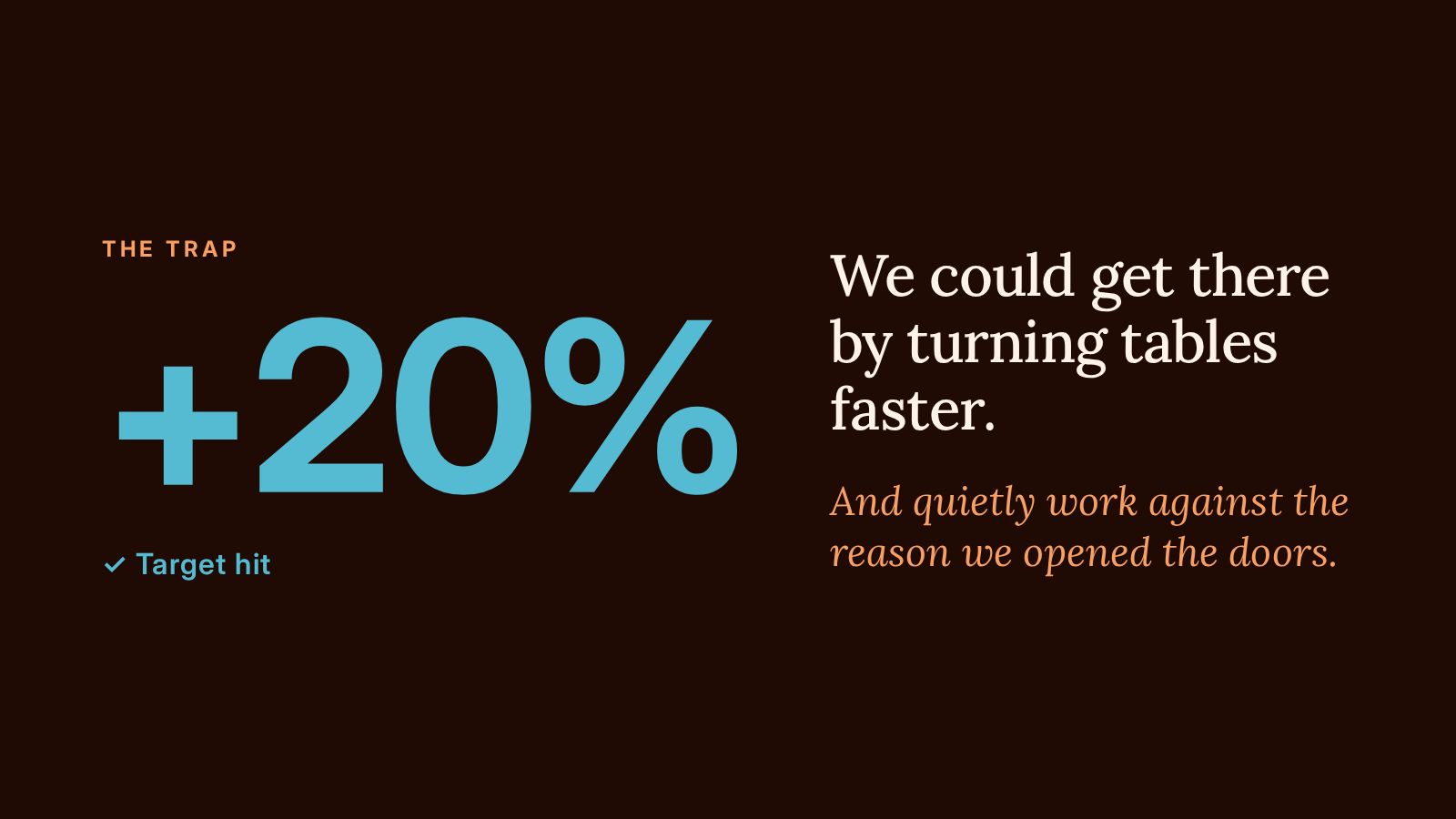
Back to our pizza place. Say the only goal on the wall is “+20% revenue next quarter.”
There’s an easy way to get there: turn tables faster. Shorter visits, quicker checks, a gentle nudge toward the door.
The target would be hit. And the business would be quietly working against the very reason it opened its doors.
That’s the risk of letting the measure stand in for the goal. Numbers are easy to game. Purpose isn’t.
To be fair, measures aren’t the enemy. Collins tells how 3M required divisions to generate 30% of revenue from products introduced in the past four years. That’s a number, and a demanding one. But it existed to bring a core value (sponsoring innovation) to life. The measure served the intent, not the other way around. That’s the aligned view.
Here is a challenge for you: Rewrite One Goal This Week
Pick one goal your leadership team is working on right now, and take it apart:
- Strip out the number. What’s left? If nothing is left, you have a target, not a goal.
- Write the intent. What are we trying to make possible, and how does it move us toward our vision?
- List the strategies. How will we do it? Check each one against your values. Would you be proud to explain it to your team?
- Then add the measures. What results, how much, by when, would show you succeeded? Include at least one measure of the intent itself, not just the money.
You’ll probably keep the number. But now it means something.
The Verdict: Keep the Scoreboard. Stop Calling It the Game.
Revenue targets aren’t going anywhere, and they shouldn’t. But a target is a scoreboard. It tells you whether you’re winning. It can’t tell you what you’re playing for.
An aligned goal starts with intent, grows through strategies that honor your values, and is proven by measures that reflect real success. Separate the three, give each its own conversation, and your growth stays true to why you started.
Note: To help your leadership team rewrite a goal the aligned way, we’ve created a guided reflection prompt based on this exact approach. Paste it into any AI tool and work through it together. See out resource page,